Cape Breton (HMCS)
From Pulp Cutter to Shipwreck Sailor: My HMCS Cape Breton Odyssey
Highfield Hunter
Roots in Inverness: A Small-Town Start
I grew up in the rural town of Inverness, Nova Scotia—a small coastal community where everyone seemed to know everyone else. Back then, in 1996, there wasn’t even specific census data for the village itself; the records covered the entire County of Inverness. The first dedicated report, in 2001, counted 1,248 residents. By the 2021 census, that number had dipped only slightly to 1,228. Like the tides along the shore, some things in Inverness never really change.
I joined the Royal Canadian Navy in May 1996. Just a few months earlier, in January, I don’t think I even knew a Navy existed. That was the reality for many of us in rural Canada at the time. We only had CBC and ATV on an old television hooked to a 20-foot roof antenna. News from the outside world came through snowy reception and local gossip. Hard to imagine now, but high-speed internet and fibre TV didn’t reach my childhood home until 2025—long after I’d left, though my mother still lives there.
The summer before, in 1995, I’d moved back home after my father passed away suddenly. I was nineteen—too young to feel that old but already learning about loss and responsibility. Work was scarce, so I fell back on cutting pulp in the woods: tough, honest labor that left your clothes stiff with frost and your hands blistered but kept you humble.
One evening at The Hoff, the local watering hole, I ran into a high school friend. Over a beer, he asked if I’d drive him to Sydney—about two hours away—for a Canadian Forces Recruiting Centre interview the next morning. I weighed it quickly: a warm highway drive to the “big city,” or another slog through foot-deep snow with a chainsaw and lunch pail. No contest.
By noon, we were there. Instead of waiting in the car, curiosity pulled me inside. That five-minute detour changed everything—from pulp and beer to sailing five of the seven seas (Arctic, North Atlantic, South Atlantic, North Pacific, and Southern) while still enjoying the beer.
A recruiter approached.
Recruiter: “Son, what do you do for a living?”
Me: “Cut wood.”
Recruiter: “Cold time of year for that. Got any hobbies?”
Me: “I enjoy scuba diving.”
Recruiter: “Why not dive for the military? Pick any trade, and you can become a diver.”
Me: “Really?”
Recruiter: “Yes, it’s that easy.”
Me: “Then sign me up as a Marine Engineering Mechanic.”

The salesman in him was strong—and I did not know it at the time, but my eyesight was too poor for Navy diving. Unlike today’s lengthy process, I was sworn in on May 3, 1996, as a “Stoker” (Marine Engineering Mechanic). Eight days later, I was at recruit school in Saint-Jean-sur-Richelieu, Quebec.
That phase could fill its own chapter, so I’ll jump to Canadian Forces Fleet School Esquimalt, where hands-on mechanical training began. Graduation came in December. During the final assembly, a weathered Chief Engineer asked if anyone was from Cape Breton. I raised my hand—the only “Caper” there.
Afterward, he pulled me aside. “I need you to help with something.” When a Chief speaks, you follow. We drove to the far side of Esquimalt Harbour, past decommissioned ships awaiting sale, scrap, or sinking. At a rusted “No Trespassing” gate, he pushed it open and waved me through.
“This,” he said, “is HMCS Cape Breton.”
The Ship’s Legacy
HMCS Cape Breton was the second Canadian warship to bear the name. The first, HMCS Cape Breton (K350), was a River-class frigate commissioned October 25, 1943, at Quebec City. She escorted convoys against U-boats from Halifax to the English Channel, supporting D-Day, before decommissioning in 1945.
The one before me was a Cape-class escort maintenance ship. Launched in 1944 at Burrard Drydock, North Vancouver, as HMS Flamborough Head—one of 21 Beachy Head-class repair ships for the Royal Navy—she measured 441 feet 6 inches long, with a 57-foot beam and 20-foot-10-inch draft (11,270 long tons full load). A triple-expansion steam engine on one shaft delivered 2,500 ihp for 11 knots.
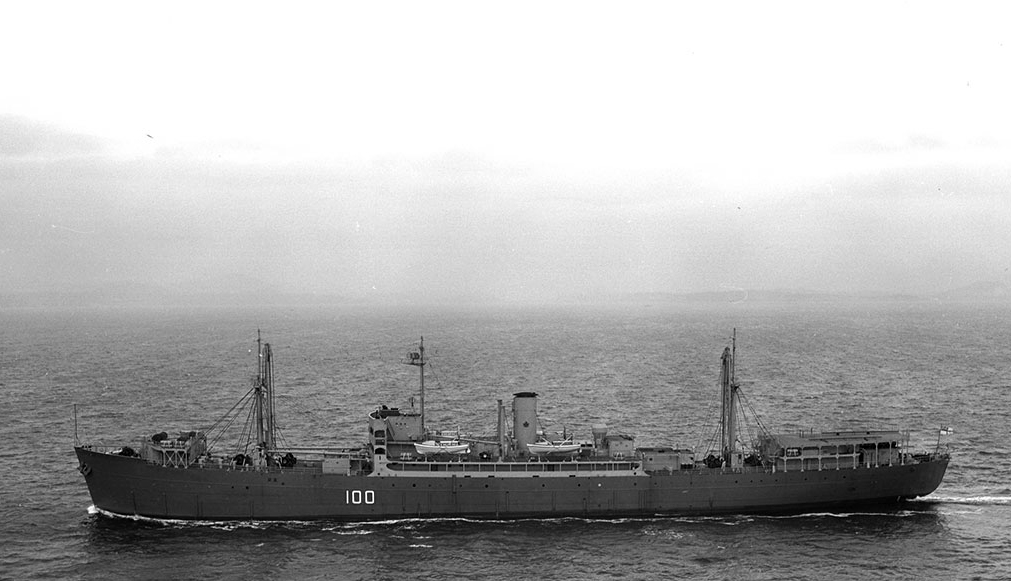
Canada bought her in 1952, commissioning HMCS Cape Breton on January 31, 1953, to bolster Cold War fleet support against Soviet subs. She trained over 300 apprentices from 1953–1958 at HMCS Naden, Esquimalt, before training shifting ashore.
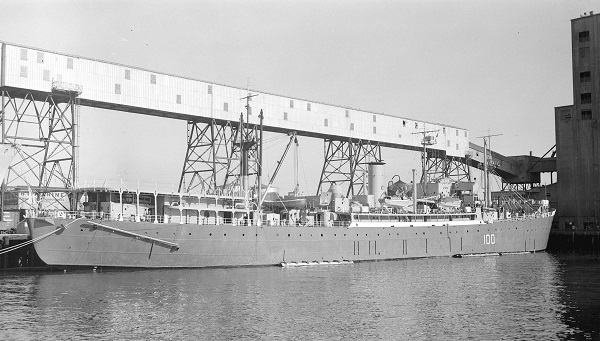
In 1959, Esquimalt refitted her with workshops, a helicopter deck, a decompression chamber, and specialized trades spaces. Recommissioned November 16, 1959, she handled hull, mechanical, electrical, and comms repairs, with sea trials in Mexico’s Magdalena Bay.
She paid off February 10, 1964, serving as Esquimalt’s towed facility until 1993’s Fleet Maintenance Facility Cape Breton replaced her. Sister HMCS Cape Scott did the same on the East Coast with the facility there being named Fleet Maintenance Facility Cape Scott.
On October 20, 2001, cleaned by the Artificial Reef Society of BC, she sank upright off Nanaimo near Snake Island—hull to 145 feet, crow’s nest at 40. She’s still the Pacific Northwest’s largest artificial reef, alive with marine growth and divers.
The Old Girl
Fresh from training, ready to conquer the seas, I crossed that gangway. December air was mild; gentle waves lapped the sleeping giant in a forgotten dockyard corner. Her faded name blistered from salt and sun, yet she held quiet dignity that tightened my chest. My first Canadian warship—decommissioned, but alive with memory’s metallic tang.
My boots thudded on weathered teak. The Chief—booming at school—spoke softly now.
“She saw storms new boats never will,” he said, hand on rail. “Went places you’ll never go. You’re starting; I’m ending—but every ship carries the stories before.”
I wish I’d asked his name. Too awed then, too young to grasp the rarity. I wonder what became of him—retired seaside, perhaps, still mentoring?
Those words endured. Thirty years on, sailors’ tales I heard echoed them; soon I had my own for the next generation. Her scale awed me. Kneeling, I traced rust-etched wood, pondering her fate.
Years later, my path took me into the Officer Corps, and once again, in 2006, I found myself in Esquimalt for summer training. This time, I had driven across the country and brought my SCUBA gear with me. On a weekend off, I joined a dive charter to visit Cape Breton again—this time beneath the surface.
With nearly a decade of naval experience behind me, the encounter felt entirely different. The ship was blanketed in anemones and kelp, pieces of her hull slowly surrendering to rust. Yet as I swam along her upper deck, I could still see the outlines of what she once was. It was haunting and beautiful. Closing my eyes, I was back on that winter morning, a young sailor listening to an old Chief whose words would define an entire career.
A Legacy Beneath the Waves

Today, building a Facebook group NS Shipwrecks and Stories for Nova Scotia’s wrecks, research loops to Cape Breton. It started with Matthew Atlantic, tracing to Pictou Shipyards’ smaller Park ships, then larger ones—and her.
That deck ignited my sea-and-wreck passion. The Chief showed more than steel; he charted a lifelong course linking service to the wrecks I now document.
Ask me about the Highfield and Suzuki offshore expedition platform — engineered for serious divers.
#HighfieldHunter #HighfieldPatrol760 #SuzukiEngines #Suzuki-300hp #HalifaxShipwrecks #BCMaritimeHistory #BritishColumbia #HMCSCapeBreton