Afghan Prince
Four Months on the Reef:
The Afghan Prince and the November Gale
Highfield Hunter
For more than four months, the Afghan Prince lay fixed on the reef off Cape Breton—held between salvage and loss. Pumps ran. Cargo was stripped. Crews remained aboard, working against tide and weather.
In London, her fate was reduced to numbers—guineas rising as confidence fell.
On the coast, the outcome was already being decided by wind and sea.
The Builder — Sunderland and the Wear
The Afghan Prince was built in 1903 on the River Wear at Sunderland, one of the most productive shipbuilding centres in the world at the turn of the twentieth century.
By that time, Sunderland yards were launching vessels in rapid succession—steel cargo steamers designed not for distinction, but for reliability. Ships like the Afghan Prince were built to work: standardized hulls, practical layouts, and triple-expansion engines that powered the global movement of goods.
She was a steel screw steamer of approximately 4,900 tons, intended for general cargo service. Nothing about her construction stood out.
That was precisely the point.
Vessel Particulars
- Name: S.S. Afghan Prince
- Type: Steel screw steamship (cargo)
- Built: 1903
- Builder: Short Bros Ltd
- Owner: Prince Line Ltd
- Tonnage: 4,923 gross tons
- Official Number: 118617
- Propulsion: Triple-expansion steam engine, single screw
- Voyage at Loss: United States to Sydney, Nova Scotia (to assemble for convoy to England)
- Cargo: General cargo including steel and approximately six million gallons of alcohol
She was large enough that her loss would matter—but not so large as to be irreplaceable within wartime trade.
A Wartime Steamer
By 1918, Atlantic shipping operated under constant pressure. German U-boats threatened established routes, and convoy systems had become essential. Sydney, Nova Scotia, served as one of the primary assembly ports.
Delays meant missing convoy windows. Missing convoys meant exposure.
Masters approaching unfamiliar coasts were balancing navigation with timing. In fog, decisions were shaped not only by seamanship, but by the urgency of war logistics.
The Afghan Prince was part of that system.
On 30 July 1918, in dense fog off Cape Breton, she ran aground on Forchu Shoal near Louisbourg.
The Grounding at Forchu
Forchu Shoal lies along an exposed stretch of coastline where reefs and shoals extend seaward beneath frequently shifting fog banks. Navigation in reduced visibility demands extreme caution.
Navigation here becomes incremental. Bearings replace visibility. Confidence replaces certainty.
The Afghan Prince approached under heavy fog. The land was obscured. The reef was invisible.
At inquiry, it was determined that the vessel had been navigated carefully up to the moment of grounding—but had maintained half speed in dense fog along an unfamiliar coast.
The court concluded that this speed was not justified. At the same time, it acknowledged wartime submarine concerns, which discouraged vessels from stopping in exposed waters.
The master was reprimanded, but retained his certificate.
It was not recklessness.
It was misjudgment within pressure.
The Master and the Margin for Error
Guyon Island and the Limits of Light
The vessel grounded off Guyon Island, a low, exposed outcrop marking the reef system.

Lighthouses mark position. They do not remove fog. They do not compensate for speed misjudged by minutes or charts lacking precision.
Standing on the island, the margin becomes clear. The distance between safe water and reef is measured in yards.
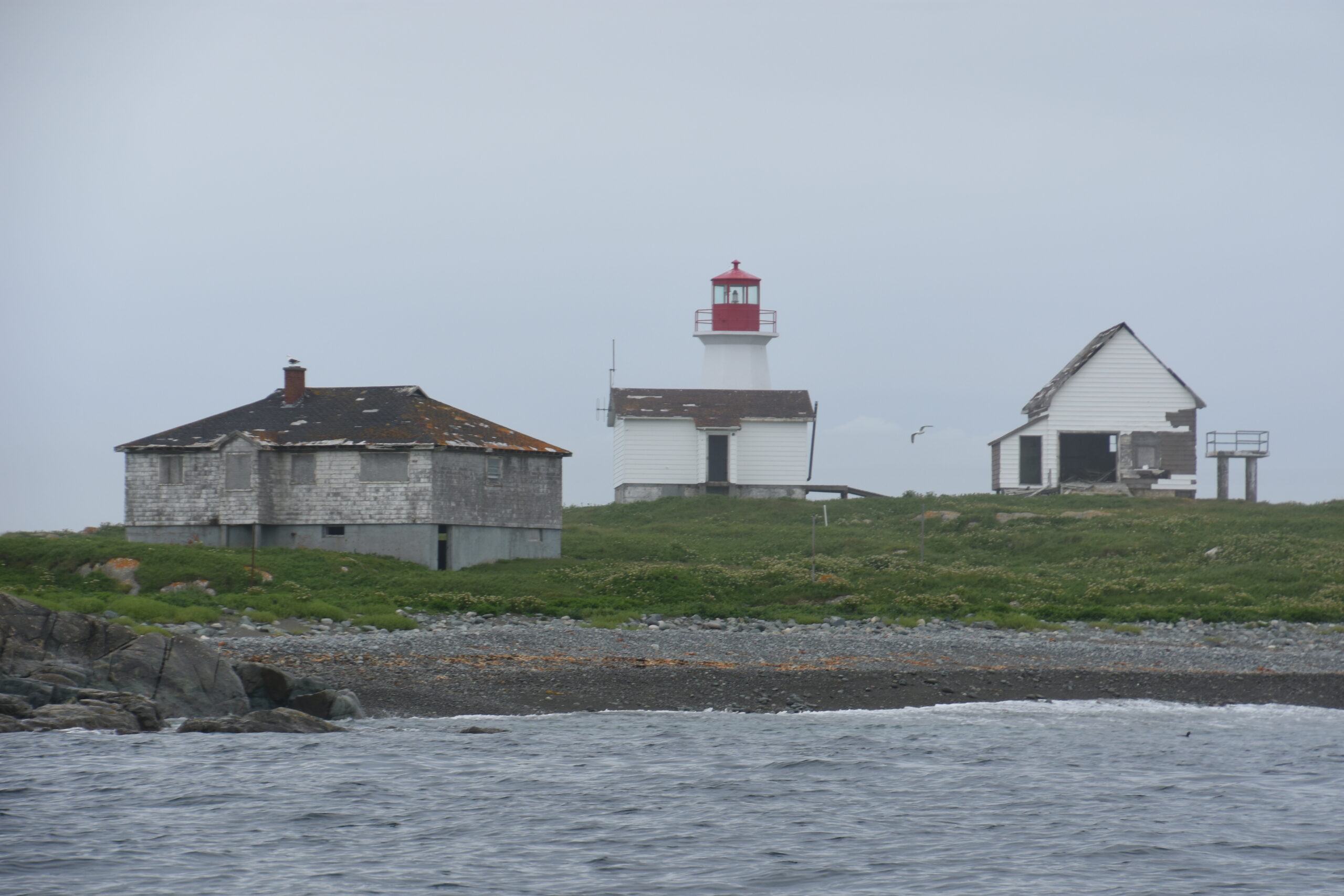
The grounding was not caused by absence of warning—but by the convergence of fog, navigation, and geography.
Gabarus and an Exposed Coast
The nearest shoreline is Gabarus, a small coastal community long familiar with the risks of offshore navigation.
This coast offers little shelter. Swell runs directly from the Atlantic. Fog is common. Even with lighthouses, strandings were not unusual.
When the Afghan Prince struck, local residents would have seen cargo begin to wash ashore.
The wreck quickly became part of the coastal environment.
The reef was not an anomaly. It was part of a coast long known for demanding precision.
Five Weeks on the Shoal
The grounding did not immediately destroy the vessel.
Salvage began quickly. Pumps were installed. Divers were engaged. Cargo was removed. At times, the engine room was kept dry.
For five weeks, crews remained aboard.
But progress was temporary.
The vessel leaked in multiple holds. Pumps failed. Refloating attempts were unsuccessful. With each tide and swell, structural strain increased.
Life aboard was not static. The ship moved constantly—lifting, settling, twisting against the reef.
There was no single moment of collapse. Only accumulation.
The ship did not need to break to be lost.
It only needed to remain where it was.
The Overdue Market: Risk in Guineas
Within days, the Afghan Prince appeared in the London overdue market.
- 2 August: 30 guineas
- Rising steadily to 35, 40, 50
- Mid-September: 60–65 guineas
- Late September: 80 guineas
Each increase reflected declining confidence.
Salvage reports suggested progress. The market did not follow.
By October, rates plateaued. The vessel remained—but did not improve.
By early November, rates rose again to 85 guineas.
The ship had not yet disappeared.
But the market had already decided.
The November Gales
Late November brought heavy gales to the Nova Scotia coast.
The hull, already weakened, could not withstand sustained storm conditions.
What had been gradual became immediate.
Steel plates failed. Seams opened. Sections gave way under repeated impact.
The wreck did not vanish instantly—but it began to break apart.
Within days, newspapers reported that the vessel had been destroyed.
The reef had held her first.
The storm finished her.
Cargo and Consequence
As the vessel broke apart, cargo came ashore.
Barrels and drums were driven onto the coastline. Some were recovered intact.
Reports cited six million gallons of alcohol and a large steel consignment.
In coastal communities like Gabarus, such cargo was not abstract—it was opportunity.
One report describes an elderly woman, nearly eighty years old, gathering drums and marking them as her own. In doing so, she secured salvage rights and earned over four hundred dollars.
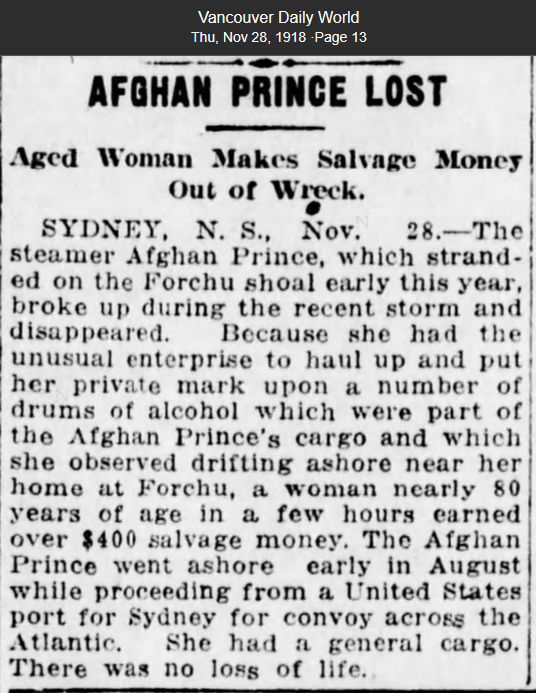
It was an extraordinary sum.
The ship had crossed the Atlantic carrying industrial cargo. In its destruction, that cargo became part of a local economy.
The sea had taken the ship.
It returned what it did not keep.
The Ship in the Newspapers
The history of the Afghan Prince survives in fragments.
Launch reports in 1903 recorded her construction and even an injury during fitting-out.
In 1918, brief marine columns tracked her grounding and salvage attempts.
Financial pages recorded her value in guineas.
Personal notices recorded loss—most notably the death of her Chief Officer, aged twenty-seven, in October 1918.
By late November, newspapers reported her final destruction.
Across time, these fragments form a complete arc:
construction, service, grounding, salvage, loss.
The Huntington Diaries: A Local Record
A more immediate record survives in the Huntington diaries of Louisbourg.
On 30 July 1918:
“British steamer ‘Afghan Prince’ ran ashore near Guyon Island.”
By 6 August, salvage was underway.
On 18 October, the diary records the death of the Chief Officer from Spanish Influenza.
Then, on 14 November:
“Terrific gale… wrecked steamer ‘Afghan Prince’… entirely disappeared.”
The entry is brief. The event was not.
The wreck intersects here with something larger—the global pandemic of 1918.
The loss was not only structural.
It was also human.
A Rarely Documented Decline
Few wrecks allow such detailed observation of loss.
Navigation, wartime pressure, salvage engineering, insurance economics, and seasonal weather—all interacting over time.
The Afghan Prince did not vanish suddenly.
She endured, weakened, and was steadily revalued before final destruction.
By the time the storm came, the outcome had already been understood.
A Coast That Repeats Itself
The loss was not unique.
Other wrecks—such as the Dufferin Bell and Langeeridge—lie within the same stretch of coastline.
Different ships. Same environment.
Fog, current, exposed reefs, and narrow margins for error.
These wrecks are not isolated points.
They are part of the same system.
The coast does not separate them.
It gathers them.
Searching for a Launch at Gabarus
Access today is not straightforward.
Old records indicated a boat launch at Gabarus. We traced the coordinates to a location overlooking the harbour.
The launch existed—at least in memory.
It lay within private property. No signage. No public access.
We chose not to cross.

Access is part of the challenge.
In 2005, the wreck was visited by charter, without recorded coordinates.
In 2018, a return search was unsuccessful.

The absence is not conclusive.
Over time, storm action and sediment can reduce even large wrecks to scattered remains.
What Remains
A recovered porthole, likely from a wreck along this coast, speaks to what time leaves behind.

Steel becomes fragments. Structure becomes memory.
The wreck itself may now be reduced—broken, scattered, or buried.
But the record remains intact.
The Process of Loss
The Afghan Prince was built as one of many.
Worked as one of many.
Lost in a way not uncommon to this coast.
What distinguishes her is not the wreck—but the record.
Few vessels allow us to observe loss as a process:
- Construction
- Service
- Grounding
- Salvage
- Financial decline
- Final destruction
Not a moment—but stages.
The Coast Today
The waters off Cape Breton appear unchanged.

The reef is still there.
The margin is still narrow.
And the outcome, given the same conditions, would not need to change.
Ask me about the Highfield and Suzuki offshore expedition platform — engineered for serious divers.
#HighfieldHunter #HighfieldPatrol760 #SuzukiEngines #Suzuki-300hp #HalifaxShipwrecks #NSMaritimeHistory #NovaScotia #CapeBreton #AfghanPrince