Costa Rican Trader
COSTA RICAN TRADER
Four Names, One Hull — A Working Ship Across Borders
Highfield Hunter
Some ships are remembered for how they end.
Others are remembered for how long they endure.
The Costa Rican Trader was not a vessel of headlines or singular catastrophe. She did not vanish in deep water or burn in the night. Instead, she worked—quietly, continuously—across decades, coastlines, and industries.
Her story is not one of a single identity, but of many.
Before she was Costa Rican Trader, she was something else.
And before that—something else again.
To understand the ship, you have to follow the names.
The Builder — Albina and the Postwar Transition
The ship that would become Costa Rican Trader was built in 1946 by Albina Engine & Machine Works in Portland, Oregon.
Originally an engineering and repair yard, Albina expanded during the Second World War to produce practical, working vessels—tugs, barges, and cargo ships built for reliability rather than recognition. These were not ships designed to stand out. They were built to move material, to operate consistently, and to remain in service.
By the time Washington Cedar was completed, the war had ended—but the system that built her had not. Shipyards continued producing vessels to support the reopening of global trade, and ships like this transitioned directly into commercial service.
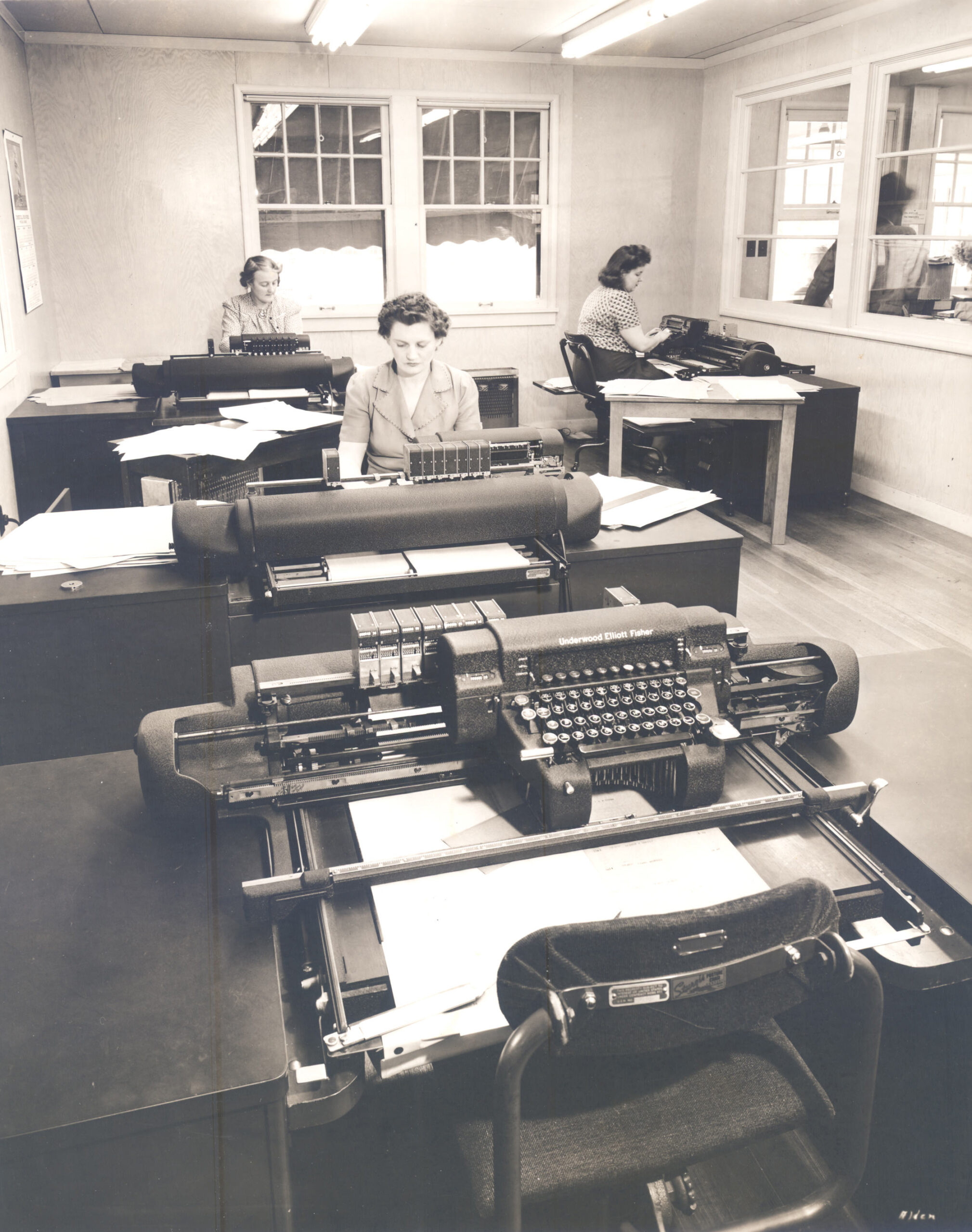
She entered that world as part of the War Shipping Administration network, moving into operation under established trade routes and experienced operators.
There was nothing remarkable about her design.
That was the point.
She was built to work—and to keep working.
The First Life — Washington Cedar
She was launched as Washington Cedar, a name tied to the timber trade of the Pacific Northwest.
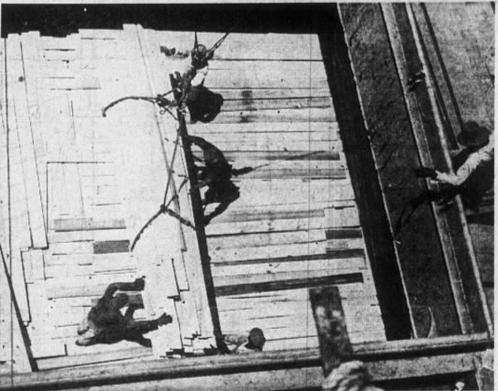
Her early voyages reflected that origin. Cargoes of southern pine moved south toward Puerto Rico and the Caribbean, part of the steady reopening of postwar trade routes. These were not small shipments—individual voyages could carry over a million feet of lumber, stacked across deck and hold, exposed to weather and requiring careful handling.

This was material destined for construction—housing, infrastructure, and expansion in regions where demand was growing quickly.
Ships like Washington Cedar formed part of what might be called the invisible fleet. They did not make headlines, but they sustained the movement of goods that made growth possible. Port to port, voyage to voyage, they operated within systems that depended on consistency more than recognition.
The work was steady.
Predictable.
And constant.
A Change in Trade — Becoming Ponce
At some point in her working life, the vessel changed hands—and with that, identity.
She became Ponce.
This marked a shift into a different kind of operation—one tied directly to industrial production. Under the ownership of Ponce Cement, part of the Ferré industrial network in Puerto Rico, the vessel entered a structured supply system feeding construction demand across the Caribbean and Florida.
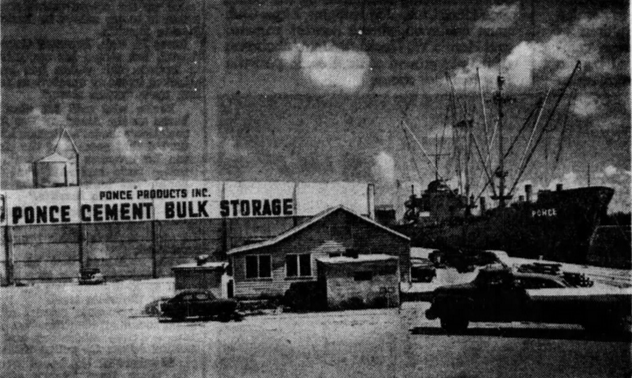
By the early 1950s, cement was in high demand. Population growth and development in South Florida created pressure on supply chains that were still adapting to postwar conditions.
Ships like Ponce became part of the solution.
The Cement Trade
Cement does not move like other cargo.
In bulk form, it behaves almost like a fluid—fine, shifting, and sensitive to moisture. It requires controlled handling, careful transfer, and systems designed specifically for its movement.
At Port Everglades, unloading Ponce was not a simple operation.
Compressed air systems drove the process. Hoses were lowered into the hold, drawing cement upward and moving it through pipes into shore-side storage. The operation was continuous, mechanical, and efficient—but it required coordination at every stage.
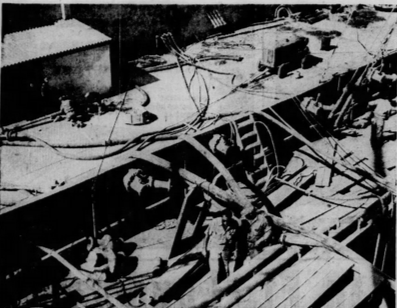
Air compressors pulsed. Material moved through enclosed lines. Fine dust settled across deck and equipment.
From ship to warehouse.
From warehouse to silo.
From silo to truck.
And from there, into the expanding footprint of South Florida’s construction boom.
Supplying Growth
There were times when cement was not simply a commodity—but a constraint.
Shortages could delay projects. Construction slowed. Demand outpaced supply.
When a vessel like Ponce arrived, it mattered.
Not symbolically—but practically.
Concrete could be poured. Foundations completed. Roads extended.
The ship did not create the boom.
But it sustained it.
Into International Trade — Mexican Trader
Under the name Mexican Trader, the vessel entered another phase—one defined less by a single company and more by global commodity movement.
Her cargo shifted again—this time to sulphur, loaded at Gulf Coast ports such as Coatzacoalcos, Mexico.
Sulphur was an industrial material, used in fertilizer production, chemical processing, and manufacturing. Like cement, it moved in volume and required specialized handling, though in different form.
The trade routes changed.
The structure of operation changed.
And by this stage, the vessel sailed under a Liberian registry—a common practice for working ships engaged in international trade during this period. Reflagging allowed vessels to operate within different regulatory and economic frameworks, extending their viability in a competitive global market.
She was no longer tied to one identity.
But she remained what she had always been:
A working ship.
Final Identity — Costa Rican Trader
By 1967, the ship was no longer young.
But she remained in service.
Across her four names—Washington Cedar, Ponce, Mexican Trader, and finally Costa Rican Trader—she had adapted to changing industries, cargoes, and ownership structures.
What remained constant was the hull itself.
Proven. Worked. Still moving.
It would be under this final name that her long working life came to an end.
The Loss — Halifax Harbour, April 28, 1967
She had been in Atlantic Canada only briefly.
After undergoing rudder repairs in Halifax, the Costa Rican Trader departed under a building southeast gale. Conditions outside the harbour were already deteriorating—winds rising, seas building, and the western approaches exposed.
At approximately 10:00 a.m., she was driven off course.

The impact forced her onto a rocky ledge near Halibut Bay, just feet from shore. With the bow fixed and the stern exposed to open water, the vessel was caught in a position that offered little chance of recovery.
Tugs were dispatched. Helicopters circled overhead.
But the sea held her fast.
The Strain
Each wave did more than strike the hull.
It lifted it.
Twisted it.
Dropped it again against rock.
With one end fixed and the other free, the structure was forced to absorb stresses it was never designed to endure. The hull began to flex—first slightly, then visibly.
Below deck, the sound would have changed.
From impact…
to strain…
to failure.
Abandon Ship
The crew—26 men—left in sequence.
A gangplank was lowered to the rock below. One by one, they crossed from steel to shore. No one was lost.
Behind them, the ship remained.
Breaking Up
By the following day, reports had shifted:
First “buckled.”
Then “breaking.”
Then “broken in two.”
The hull had failed.

Photographs show her lying against the rock—structure distorted, deck compromised, the accumulated weight of years reduced to something the sea could dismantle piece by piece.
A salvage expert would later describe any attempt to recover her as “like trying to refloat a sieve.”
The declaration came quickly:
Total loss.
The Wreck Today
The remains of the Costa Rican Trader lie where she grounded—along the exposed coastline near Halibut Bay.
Time and sea have done what salvage could not.
What was once a continuous structure is now scattered—sections collapsed, shifted, or carried away entirely. The site remains exposed, shaped by the same surge and conditions that ended the vessel’s working life.
It is not a sheltered wreck.
It is a reminder.
Why This Ship Matters
The Costa Rican Trader is not defined by her loss alone.
What makes her story compelling is continuity.
Across her names, she reflects the movement of industry itself:
- timber and postwar reconstruction
- cement and industrial expansion
- bulk cargo and global trade
She adapted.
She endured.
She worked.
And like many ships of her kind, she became visible only at the end.
~~~
She was never famous.
But she was always moving.
And sometimes, that’s the better story.
Ask me about the Highfield and Suzuki offshore expedition platform — engineered for serious divers.
#HighfieldHunter #HighfieldPatrol760 #SuzukiEngines #Suzuki-300hp #HalifaxShipwrecks #NSMaritimeHistory #NovaScotia #Halifax #CostaRicanTrader