Kenkerry
A Hundred Yards from Shore: The Loss of the Kenkerry
Highfield Hunter
The storm came in hard off the Atlantic.
By the evening of January 18, 1935, visibility along the approaches to Halifax had collapsed into blowing snow and darkness. Somewhere just outside the harbour, beyond the lights that marked safety, a freighter pressed forward at reduced speed—feeling her way through conditions that left little margin for error.
She did not see the coast.
She felt it.
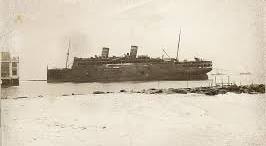
What the storm concealed that night was revealed by daylight.
The British freighter Kenkerry, 3,930 tons, out of Newcastle, had left Havana bound for Halifax. From there, she was to load grain for the return crossing to the United Kingdom. It was routine—another leg in a working life defined by movement between ports.
But the timing was wrong.
As she approached the Nova Scotia coast, snow thickened, wind built, and the shoreline disappeared.
Chief Engineer John Dove would later describe the moment:
“We were going ahead at dead slow when I felt her bump… I ordered full speed astern. The fires were low. The steam didn’t last long.”
The ship had already struck.
Why She Never Had a Chance
What followed was not a failure of seamanship alone.
It was a convergence of limits.
The Kenkerry was navigating in near-zero visibility. There was no radar. No electronic positioning. Only dead reckoning, soundings, and what could be seen through the storm.
In those conditions, navigation became an act of judgment rather than certainty.
Courses were estimated. Distances inferred. Soundings taken when possible, but limited by depth, timing, and the difficulty of working in heavy weather. A ship could be closer to land than believed—or further—without any clear indication of which was true.
Along this stretch of coast, that uncertainty mattered.
The approaches to Halifax are not forgiving in winter. Wind, current, and sea all work against a vessel standing in too close. A ship set even slightly off her intended position can be carried inward without realizing it, the margin for correction shrinking with each minute.
And once that margin is gone, there is no gradual warning.
Only impact.
That margin had already narrowed.
When the ship struck, even at reduced speed, the outcome shifted immediately. Driven toward a lee shore, the vessel could not easily free herself.
The order for full speed astern came quickly.
But the Kenkerry was a coal-fired steamer.
With fires banked for slow approach, steam pressure was limited. When the engines were reversed, what remained was used quickly—and once exhausted, there was no immediate recovery.
Within minutes, propulsion was gone.
Water entered the stokehold. Power failed. The ship could no longer move.
From that point forward, she was no longer navigating.
She was fixed.
And with each wave, she was driven further onto the rock beneath her.
A Hundred Yards from Shore
The Kenkerry had grounded on Black Point Rocks near Portuguese Cove—less than a hundred yards from land.
Close enough to hear the shore.
Close enough to survive.
But not easily.
Heavy Atlantic rollers lifted and dropped the vessel onto the ledge beneath her hull. Steel plates strained under repeated impact. Each wave drove her further into place.
From the ship, nothing could be seen.
From shore, nothing could be reached.
It was a situation as old as the coast itself—ship and land separated by a distance that could not be crossed.
The Coast in Winter
In summer, this coastline can be read.
Landmarks hold. Distances make sense. A vessel can judge its position against what it sees.
In winter, that changes.
Snow removes the horizon. Wind flattens sound. Lights disappear or distort through blowing ice. What should be a defined shoreline becomes something uncertain—present, but not visible in any reliable way.
For ships approaching Halifax in these conditions, the danger was not always obvious.
It was hidden in distance.

It was not a rescue vessel that reached her first.
It was sound.
The ship’s siren carried through the storm to the fishermen of Portuguese Cove. Drawn to the cliffs, they listened, then watched for signs through the snow.
When they saw her, she was already doomed.
A line had to be established.
From the deck, a rocket was fired into the darkness, carrying a thin line toward shore. The first attempt failed. The line sagged and could not be secured.
A second shot was fired.
This time, it held.
A rope stretched across the water—one hundred yards between ship and land.
It was enough.
The Line
The system was simple—and unforgiving.
A breeches buoy, a canvas sling suspended from the line, would carry each man across.
But the line sagged into the sea. At its lowest point, the water took hold.
Each man would be dragged through it.
There was no clean passage.
Only effort.
Crossing
Someone had to go first.
Seaman Stanley Davies volunteered.
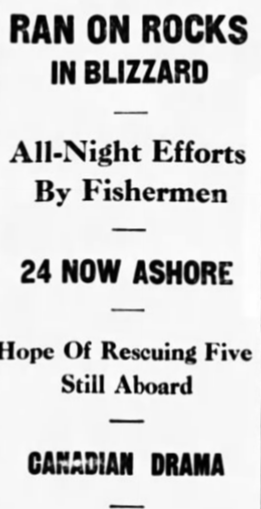
He climbed into the buoy and was pushed out into the storm.
The line dropped.
Instead of riding above the water, he was forced into it.
Waves broke over him. He pulled himself forward, hand over hand.
He didn’t make it.
Halfway across, he was overcome and hauled back to the ship—frozen and barely conscious.
Another attempt was made.
This time, it worked.
But “worked” did not mean safe.
Each man entering the buoy faced the same passage—down into the lowest point of the line, where the full weight of the sea took hold. The water there was not simply cold; it was violent, pulling and dragging at anyone caught in it.
Progress was measured in effort.
Hands gripped rope stiffened by ice. Bodies were submerged, lifted, and submerged again. The crossing became less a movement across distance and more a fight to remain attached to the line itself.
On shore, the fishermen waited in the surf.
They did not stand back from it. They moved into it—timing their steps between waves, reaching out as each man approached, pulling them clear before the next surge could take them back.
There was no clean transfer from ship to land.
Only a narrow moment where one gave way to the other.
One by one, the crew began to cross.
A Night Without End
The rescue took hours.
There was no speed—only repetition. Each man clipped in. Each man fought the same stretch of water.
On shore, fishermen waded into the surf to pull them clear.
On board, the crew waited.
The ship continued to break.
Lifeboats were useless—one smashed before it could be launched.
The line was the only way off.
There was no second option.
No delay.
Only the next man.
Breaking Apart
Before dawn, the Kenkerry began to come apart.
The stern went first.
The remaining hull sagged, then split beneath the strain.
By then, most of the crew had made it ashore.
Only two remained.
Captain Duncan Milne.
Chief Engineer John Dove.
The Last Crossing
Dove went first. He made it.
The line was sent back.
Now, the captain stood alone.
There was nothing left to hold the ship together—and nothing left to wait for.
He stepped into the breeches buoy.
Accounts differ in detail—but not in what followed.
A wave struck.
He was torn from the line and thrown into the sea.
Those watching saw him surface.
Then they saw nothing more.
All Saved—But One

Twenty-eight men reached shore.
One did not.
After the Storm
The men were taken into homes in Portuguese Cove—frozen, exhausted, barely able to stand.
From there, they were brought to Halifax.
The journey inland was short in distance, but not in experience.
Snow still blocked the roads. What should have taken less than an hour stretched into several, the men carried through conditions that had not yet eased. Many were too exhausted to speak. Others could not recall the journey at all.
One of them would later say simply:
“What happened after that is all a blank.”
They had come ashore alive.
But the night had not yet released them.
Then home.
They sailed back across the Atlantic aboard another ship, passing the wreck along the way.
They lined the rail and saluted.
What Remained

By daylight, the wreck was already reduced to a broken hull.
Steel exposed. Structure gone.
It was no longer a ship.
It was a marker.
What happened that night did not end at the water’s edge.
It carried forward—with the men who survived, and with the place where it occurred.
The Distance
Today, the remains of the Kenkerry still lie off Black Point.
The distance has not changed.
It is still less than a hundred yards.
Close enough to see land.
Close enough to hear it.
And in the wrong conditions—
far enough that it might as well not be there at all.
Ask me about the Highfield and Suzuki offshore expedition platform — engineered for serious divers.
#HighfieldHunter #HighfieldPatrol760 #SuzukiEngines #Suzuki-300hp #HalifaxShipwrecks #NSMaritimeHistory #NovaScotia #Kenkerry