City of Washington
Into the Fog: The Loss of the City of Washington
Highfield Hunter
South Coast of Nova Scotia – July 5, 1873
The fog was so thick that afternoon that the sea seemed to end only a few yards from the ship.
For days, the passengers aboard the steamship City of Washington had lived with the sound of the fog-horn—its hollow note echoing out into the Atlantic, marking time in a place where nothing else could be seen. The voyage had settled into rhythm: engines turning steadily beneath the deck, conversations in the saloon, emigrants gathering where they could find air above.
Beyond the rail, there was nothing.
The horizon had vanished. The sky and sea had merged into a single grey field.
Shortly after half past one, that routine ended.
There came a sudden jolt beneath the hull.
Passengers felt two light bumps—then a violent shudder, longer this time, as iron scraped against rock. The entire ship trembled.
The City of Washington had run full speed onto Gull Rock Shoal, along the coast of Nova Scotia.
No one aboard knew it yet.
The fog still held.
The System Behind the Voyage
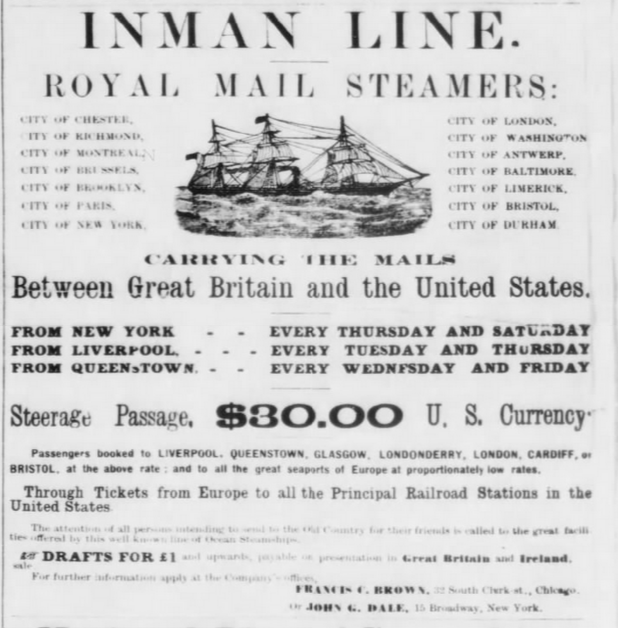
By the time the City of Washington pushed west into that fog, she was part of a much larger system.
The North Atlantic had become a corridor—of movement, of industry, of departure. Steam power had transformed ocean travel. Where sail had once meant uncertainty, steam promised schedule.
Companies like the Inman Line built their reputation on that promise.
Their ships carried more than cargo. They carried people in motion—families leaving Ireland, labourers from Britain, tradesmen from across Europe. Above them travelled cabin passengers with means. Below, hundreds crossed in steerage, bound by destination rather than circumstance.
All of them shared the same ocean.
And the same risks.
The Ship – Built for the Crossing
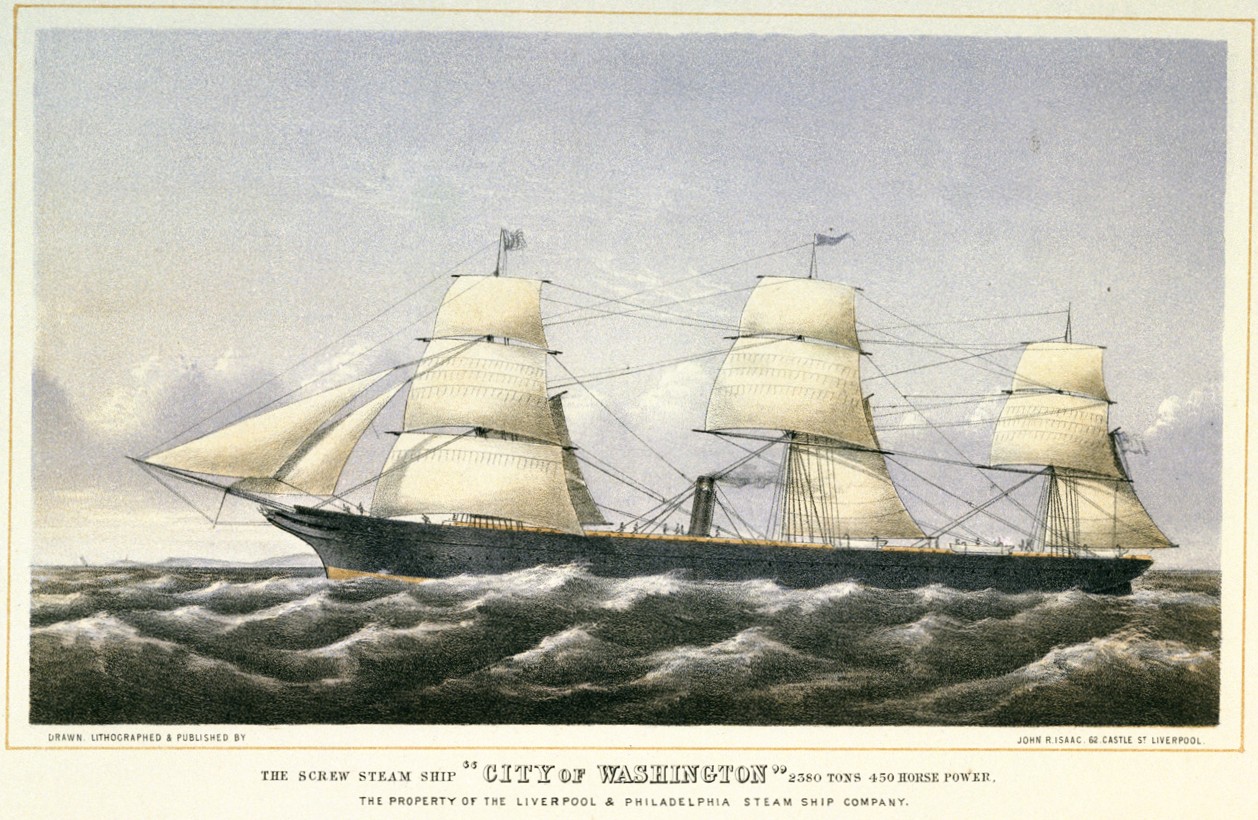
Built in 1855 at Glasgow, the City of Washington belonged to a transitional generation of ocean vessels.
She was an iron-hulled screw steamer—over 300 feet in length—combining steam propulsion with a full sailing rig. It was a design born of uncertainty. Steam was advancing, but not yet trusted on its own.
Inside, the divisions of the era were clear.
Cabin passengers occupied the central saloon spaces. Forward and aft, steerage compartments carried hundreds of emigrants. On her final voyage, she held:
- 28 cabin passengers
- More than 480 in steerage
- Nearly 100 officers and crew
Below them lay cargo typical of an industrial age—steel rails, iron bundles, manufactured goods bound for American expansion.
She had made this crossing for nearly two decades.
Nothing about this voyage suggested it would be different.
For nearly two decades, she had moved back and forth across the Atlantic, part of a system that depended on repetition. Departures, crossings, arrivals—measured not in individual voyages, but in schedules kept and routes maintained. Ships like the City of Washington were not exceptional. They were expected to work.
And that expectation shaped how they were navigated.
The ocean was not unknown—but it was not forgiving. Precision mattered, but so did confidence. Masters were expected to keep time, to make landfall when expected, to move through conditions that could not always be seen or measured.
It was within that balance—between certainty and assumption—that small errors could begin.
The Voyage – Into the Grey
She left Liverpool on 24 June 1873.
At Queenstown, more passengers boarded before the ship turned west into the Atlantic.
Then the fog came.
Not briefly. Not in passing.
It settled—and remained.
Day after day, the sky was hidden. Without sun or stars, navigation shifted to estimation. Position was no longer measured—it was believed.
Speed. Heading. Time.
Dead reckoning.
For short periods, it worked. Over days, small uncertainties accumulated.
Still, the ship maintained speed.
Still, the fog-horn sounded.
Still, the passengers waited.
And somewhere on deck, they leaned into the rail, staring into the grey—believing there was nothing there.
What they could not see was not empty water.
It was distance closing.
The Nova Scotia Coast
For days, the ship had moved without a confirmed position.
Only two celestial observations had been taken early in the voyage. After that, the fog held. Without sun or stars, navigation relied entirely on estimation—course, speed, and time carried forward without correction.
No soundings were taken as the vessel approached North America.
The crew believed they were farther south.
They were not.
The coast of Nova Scotia does not announce itself.
It waits.
Reefs and shoals extend outward beneath the surface, hidden by fog that can reduce visibility to nothing. Only months earlier, the liner Atlantic had been lost along the same coast with heavy loss of life.
But on 5 July, the passengers aboard the City of Washington believed themselves far from danger.
Inside, the engines turned steadily.
Then the ship struck.
The Impact
The grounding came without warning.
The vessel drove onto Gull Rock Shoal, less than half a mile from shore—though no one aboard could see it. Confusion spread quickly. Some believed they had struck offshore banks. Others admitted they did not know where they were.
In reality, land lay just beyond the fog.
And help was closer than anyone realized.
The Rescue at Port Le Bear
At first, there was only silence.
The fog-horn sounded. Signal guns were fired.
Then—unexpectedly—a reply.
A voice.
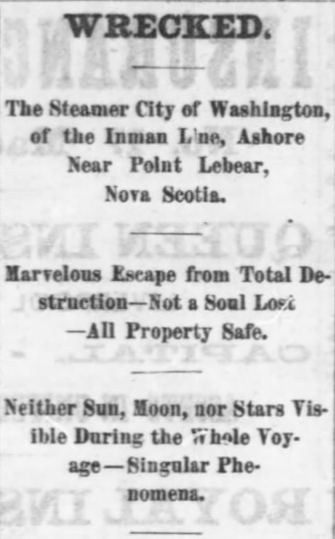
Through the mist, a small boat appeared, carrying two local fishermen—Cornelius Swanburg and William Ferguson. They had heard the signals and made their way out to the stranded liner.
“Where are we?” came the question from the deck.
“Off the coast of Nova Scotia.”
“How far from land?”
“Half a mile.”
Relief spread immediately.
Moments earlier, many aboard had believed themselves still far out in the Atlantic—days from land, beyond immediate help. The realization that shore lay within reach changed everything. What had been uncertainty became urgency.
Now, the task was not survival at sea—but getting everyone off the ship before conditions changed.
Evacuation began at once. Lifeboats were lowered, and order was maintained under strict control. Women and children were sent first. Despite the circumstances, passengers remained disciplined.
Within three hours, every person aboard had been landed safely on shore.
Refuge on the Shore
The small community at Port Le Bear absorbed the survivors as best it could.
Cabin passengers were taken into homes. Steerage passengers and crew gathered along the shoreline, where fires were built and temporary shelter arranged in barns and outbuildings.
Food was shared. Groups formed along familiar lines—language, nationality, family.
Behind them, hidden again by fog, the ship remained grounded.
But the danger had passed.
The Ship Breaks Apart
For several days, the City of Washington remained intact on the shoal.
Salvage began almost immediately. Cargo and provisions were brought ashore while conditions held.
Then the sea changed.
On 10 July, heavy swell began to roll in. Each wave lifted the hull and dropped it again against the rock beneath. The strain built gradually—until it did not.
The ship broke.
The forward section collapsed and sank. Masts fell. Cargo scattered into the surrounding waters.
What had carried hundreds safely across the Atlantic was reduced, piece by piece, by the same sea it had crossed.
In the days following the wreck, news travelled slowly. It would take nearly two days for word to reach Halifax, and longer still for consistent accounts to emerge in newspapers across the Atlantic.
By then, the ship was already beginning to disappear.
What Went Wrong
The cause was not a single failure.
It was accumulation.
A series of decisions made in conditions where confirmation was no longer possible.
Days of fog prevented celestial navigation. The crew relied entirely on dead reckoning. No soundings were taken as the ship approached North America—an oversight that might have revealed their position.
There was also the possibility of compass deviation, caused by the iron hull and cargo.
The Halifax inquiry concluded that the captain had exercised poor judgment in maintaining speed without verifying position.
His certificate was suspended.
But the outcome had already been decided long before that ruling.


A Narrow Escape
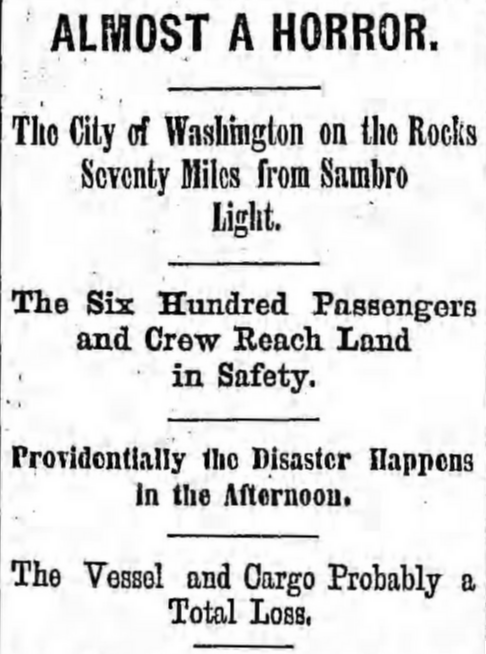
In the end, the loss of the City of Washington became something rare in the history of the North Atlantic.
A disaster without death.
More than five hundred people had crossed an ocean, entered a wall of fog, and driven full speed onto a hidden shoal.
And yet, within hours, every one of them stood on land.
Alive.
Had the timing been different, the story would have been told another way.
Had the ship struck at night, or in heavy seas, there would have been no orderly evacuation. No small boats finding their way through the fog.
Only wreckage.
Only loss.
The answers, when they came, were measured in degrees, miles, and decisions made in fog.
But out along the coast of Nova Scotia, none of that mattered anymore.
There, the sea had already taken what it would.
The City of Washington lay broken across the shoal where she had come to rest—her hull opened, her cargo scattered, her passage finished within sight of land.
The fog still comes in along that coast.
It still closes the horizon.
And somewhere beneath it, what remains of the ship waits in the same place it settled in July of 1873.
Not as a tragedy.
But as a margin.
A distance measured not in miles—
but in how close more than five hundred lives came to being lost.
Ask me about the Highfield and Suzuki offshore expedition platform — engineered for serious divers.
#HighfieldHunter #HighfieldPatrol760 #SuzukiEngines #Suzuki-300hp #HalifaxShipwrecks #NSMaritimeHistory #NovaScotia #CityOfWashington