Gertrude DeCosta
The Gertrude DeCosta
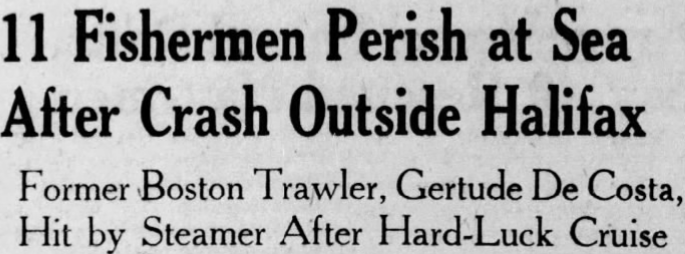
A Collision in the Fog — Halifax Harbour, March 18, 1950
Highfield Hunter
A Harbour That Does Not Forgive
Halifax Harbour has long been described as a place of refuge.
For vessels crossing the North Atlantic, it offered shelter—deep water, protection from open seas, and a direct connection to one of Canada’s most important ports. But for those who worked within it, the harbour was not simply a destination.
It was a system.
Traffic moved along understood paths shaped by shoals, channels, and the narrowing entrance between McNabs Island and the mainland. Vessels inbound from the Atlantic converged with outbound ships leaving the inner harbour. Even in clear weather, it was a place that demanded attention.
In fog, it demanded judgment.
Distances collapsed. Lights appeared without context. A vessel that seemed safely off might already be committed to a closing course. Sound signals—whistles—were meant to bridge that uncertainty, but even they could be lost in shifting air.
Traffic did not stop for fog.
Fishing vessels returned from the Banks. Coastal freighters moved between ports. Larger ships maintained schedule.
It was within this working, compressed environment that two vessels moved toward one another.
One inbound.
One outbound.
Neither fully aware of how little time remained.
The Vessel
The Gertrude DeCosta was a working fishing schooner of a type once common along the Nova Scotia coast.
Launched in 1912 and registered out of Yarmouth, she measured approximately 115 feet and represented a transitional era in maritime design—diesel-powered, but still carrying sail when conditions allowed. By 1950, vessels like her were no longer modern, but they remained essential.
She operated within the fleet of Sweeney Fisheries Ltd., one of the largest fishing enterprises on the East Coast. From Yarmouth, Sweeney vessels worked the Grand Banks and beyond, forming part of a broader system that extended from catching to processing and distribution.
Fishing on the Banks was not a single task, but a coordinated system.

Dories formed its core. Each day, small boats were launched from the schooner, spreading out across the fishing grounds. At day’s end, they returned, their catch hauled aboard and processed.
It was efficient.
It was also dangerous.
Days earlier, one crewman had been lost when a dory overturned. Another—Morton Tanner—survived.
The voyage continued.
It always did.
But such events changed the tone aboard. By the time the DeCosta turned toward Halifax, she carried more than her catch.
She carried the weight of what had already happened.
The Collision — The Moment It Failed
In the early hours of March 18, 1950, the Gertrude DeCosta approached Halifax under diesel power.
The watch was set. The vessel held her course. Ahead, the glow of Halifax spread through the fog.
Somewhere within that same confined space, the Island Connector was outbound—larger, faster, and operating within the same narrow approach.
At first, there was no alarm.
A light appeared.
Then another.
To those aboard the DeCosta, the lights resolved into the familiar pattern of an approaching vessel—one that, by their understanding, would pass clear.
The assumption was made:
They had the right of way.
For a time, that assumption held.
But in fog, time compresses.
Distance closes faster than it can be judged. A vessel that should alter course does not—or does so too late to matter.
Recognition came suddenly.
The captain reacted.
“Haul her hard over.”
The wheel was put to port.
But by then, the geometry of the two vessels had already collapsed.
Out of the fog, the Island Connector emerged—not as a distant shape, but as an immediate presence.
There was no room left.
No time to recover.
The freighter struck the schooner aft of the main rigging.
The hull opened.
Water entered immediately.
And within one to two minutes, the Gertrude DeCosta was gone.
What the Survivors Saw
What followed was not a single account, but several—each revealing a different part of the same moment.
At approximately 2:00 AM, Robert Parker was at the wheel. The vessel was making steady headway at roughly six knots. The first sign of danger came as lights on the starboard bow—distant, uncertain.
The assumption remained: the other vessel would alter course.
It did not.
Captain Haslem Knickle gave the order to turn. The wheel was put over hard to port.
Moments later, the Island Connector emerged from the fog.
The collision was sudden and violent.
The schooner was struck aft. The hull opened immediately. There was no time to launch boats or organize escape.
On deck, men called for knives to cut the dories loose.
No one had one.
The vessel began to sink almost at once.
Rigging tightened. Lines became entanglement. Movement was restricted just as it was most needed.
Men climbed instinctively toward the mainmast.
There were too many.
There was too little time.
Then the vessel disappeared beneath them.
In the Water
Survival did not end with escape from the vessel.
It began again in the water.
Edward Tanner, the ship’s cook, went down with the schooner and surfaced among wreckage. Others were thrown clear or dragged under before resurfacing.
Parker was pulled from the wheelhouse and entangled in rigging, his hand crushed against the freighter’s hull before he broke free.
Some reached floating debris.
Some reached dories that had come loose.
Some reached lines thrown from the Island Connector.
Others did not surface.
The water was cold—damned cold.
Men who had never swum before found themselves doing so.
Rescue and Aftermath
The crew of the Island Connector responded quickly.
Ropes and cargo nets were thrown over the side. Survivors were hauled aboard—injured, exhausted, and in shock.
Inside, they gathered in the engine room, recounting what had happened in fragments.
Two bodies were recovered immediately.
Others were missing.
Hours later, one washed ashore at Maugher’s Beach.
By daylight, the news had spread through Halifax.
Fishing vessels were not anonymous. Crews were known. Names travelled quickly—from dock to shore, from harbour to home.
The harbour did not close.
Traffic continued.
But the awareness remained.
The Dead
Eleven men were lost.
Among them were Captain R. Haslem Knickle of Lunenburg and his father, Otto. George Schrader and his son Dave. Morton Tanner—who had survived the earlier dory accident only days before.
In several cases, fathers and sons did not return.
The vessel was gone in minutes.
And with it, nearly two-thirds of her crew.
The loss was not individual.
It was generational.

The Inquiry
A formal inquiry followed.
Testimony from survivors described the lights they saw, the signals they did not hear, and the final moments before impact.
Three questions defined the proceedings:
Speed.
Position.
Responsibility.
Counsel for the schooner argued the Island Connector was travelling too fast for fog. Others suggested the schooner had altered course into danger.
Between those positions stood the central fact:
Two vessels had approached one another in fog.
Each had acted.
Neither had acted in time.
What Remains
The Gertrude DeCosta does not remain intact on the seabed.
Like many working vessels lost in confined waters, she has broken apart—reduced to scattered remnants shaped by time and current.
But the wreck is not the only thing that remains.
Across Nova Scotia, the memory endured—not through formal record alone, but through families, conversations, and quiet acknowledgment.
Fishing vessels are built to work.
They are not intended to endure in memory.
And yet, when loss comes suddenly—without warning—they become something else.
Not symbols.
But markers.
Of a moment when routine failed.
When experience was not enough.
When the sea took more than it gave.
Closing
The fog that morning eventually lifted.
What happened within it did not.
Ask me about the Highfield and Suzuki offshore expedition platform — engineered for serious divers.
#HighfieldHunter #HighfieldPatrol760 #SuzukiEngines #Suzuki-300hp #HalifaxShipwrecks #NSMaritimeHistory #NovaScotia #Halifax #GertrudeDeCosta